A few years ago I wrote a blogpost titled My Mum the Pilot, the true story of my mum Dhira Chaliha who became Assam’s first woman pilot aged 21 in 1961. It was a remarkable achievement given the time and place, the pressures from society that held that the sky was no workplace for women, not to mention the technical skill and courage to fly in small planes without radios or parachutes.
I ended that post with the final sentence “It won’t surprise me if she does (fly) one day, for she’s my mum… the pilot.” I didn’t realise it then, but as events after the blog post unfolded, it turned out that the words were quite prophetic.

My colleague James Lee emailed me to say his father-in-law, former British Airways Jumbo Jet pilot and instructor Captain John Towell, had read my blogpost and he was keen to take my mum up in his iconic 1940s biplane, the Tiger Moth, which he kept at an airfield close to London.
My mum was living in India at the time and she was elated at the chance to take to the skies again. Destiny was calling.
But then events didn’t go to plan; covid happened; air travel ceased; lockdowns came and went, and my mum turned from 80 to 85 in the blink of an eye.
It appeared her last chance to fly had flown by.
But John’s offer to reunite my mum with her first love, flying, remained.
In September 2025 my mum came to the UK again and memories of the four decades she spent in London came flooding back. We visited Trafalgar Square, Buckingham Palace (where she once met the Queen at a garden party), Madam Tussauds and Big Ben.
But the icing on the cake was irrefutable .
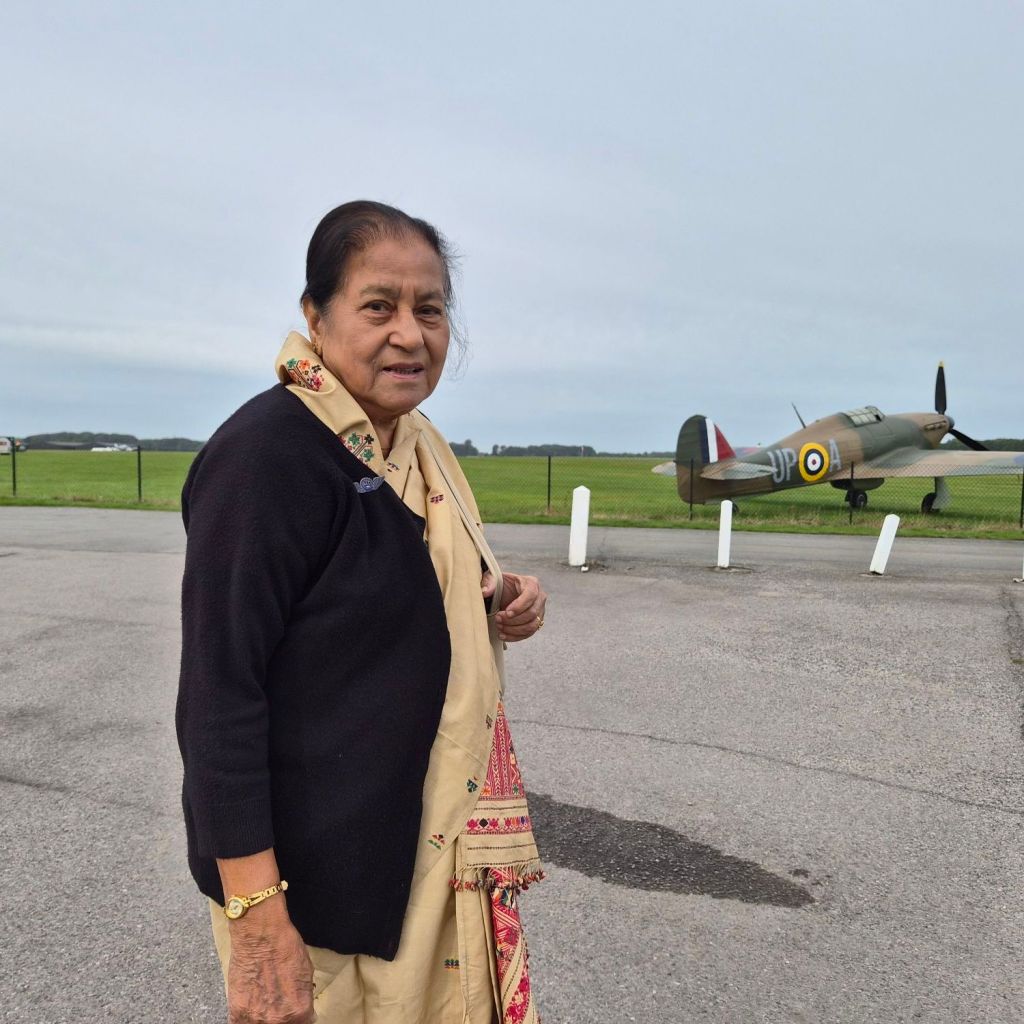
Flight day arrived; it would have to be an early start as rain was forecast at lunchtime (and the Tiger Moth has an open cockpit). So, early on that fresh September morning, I drove to my mum’s and as she came down the steps I saw that she was wearing her hand-embroidered, golden-silk mekhela sador, a two piece sari, which is uniquely Assamese as the cloth is woven from paat, a special golden silk endemic to Assam.
Because of her choice of dress, I assumed mum wouldn’t be flying.
As her son, I should have known better.
We drove to White Waltham Airfield just west of London, one of the most famous airfields in the world dating from the 1930s.
We entered the historic clubhouse, filled with the smell of coffee and cakes and the chatter of pilots readying for their flights; Captain Towell and his wife Linda welcomed us and we chatted over a cup of tea. (Assam, naturally).
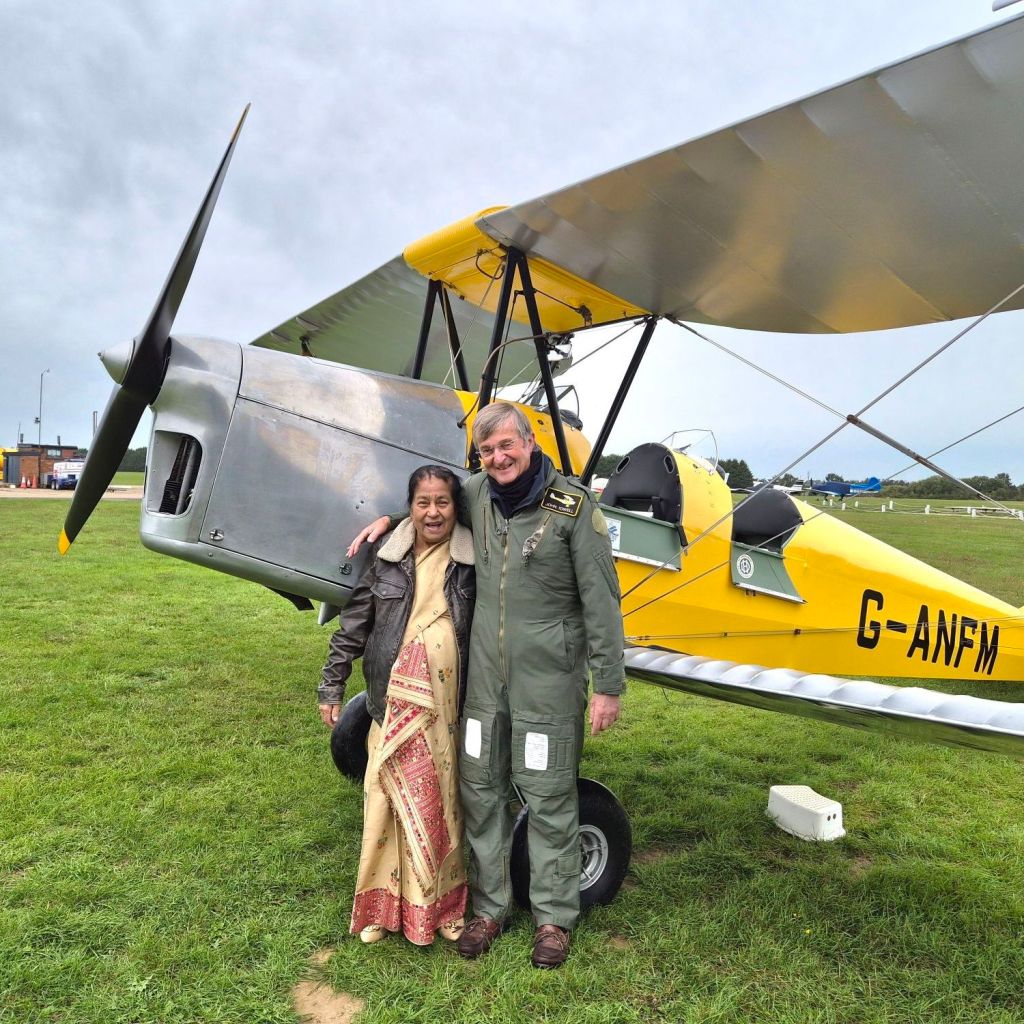
John is very much how you imagine a gentleman pilot: tall and slim with a handsome moustache, a ready smile with a humour that puts people at ease. Someone who wouldn’t be out of place in the halcyon days of those magnificent men in their flying machines, bedecked with goggles and fluttering silk scarves.
We walked past the aircraft on the grass. There were vintage warbirds like the Spitfire, aerobatic planes, private jets and gliders all pointing their noses towards the runway, yearning to have their chocks pulled away, to be in the skies once more.
Of all the planes on the grass, one stood out; its bright yellow colouring was resplendent amongst the grey fuselages of its neighbours. It sat on the grass prettily, like a yellow butterfly amongst moths.
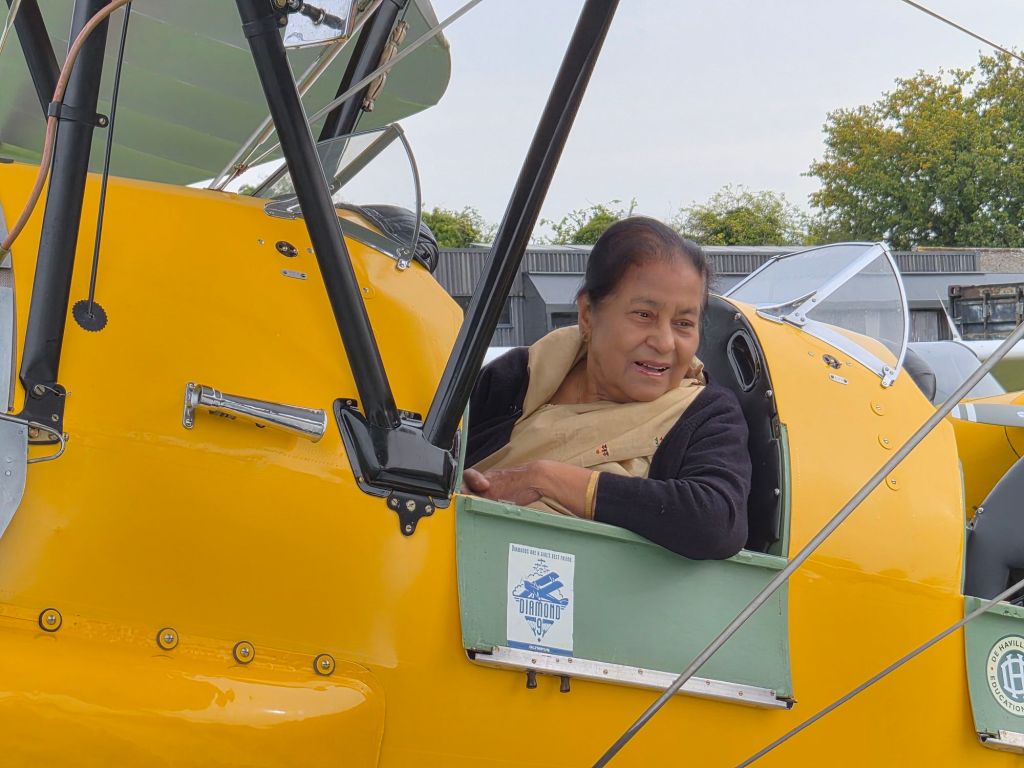
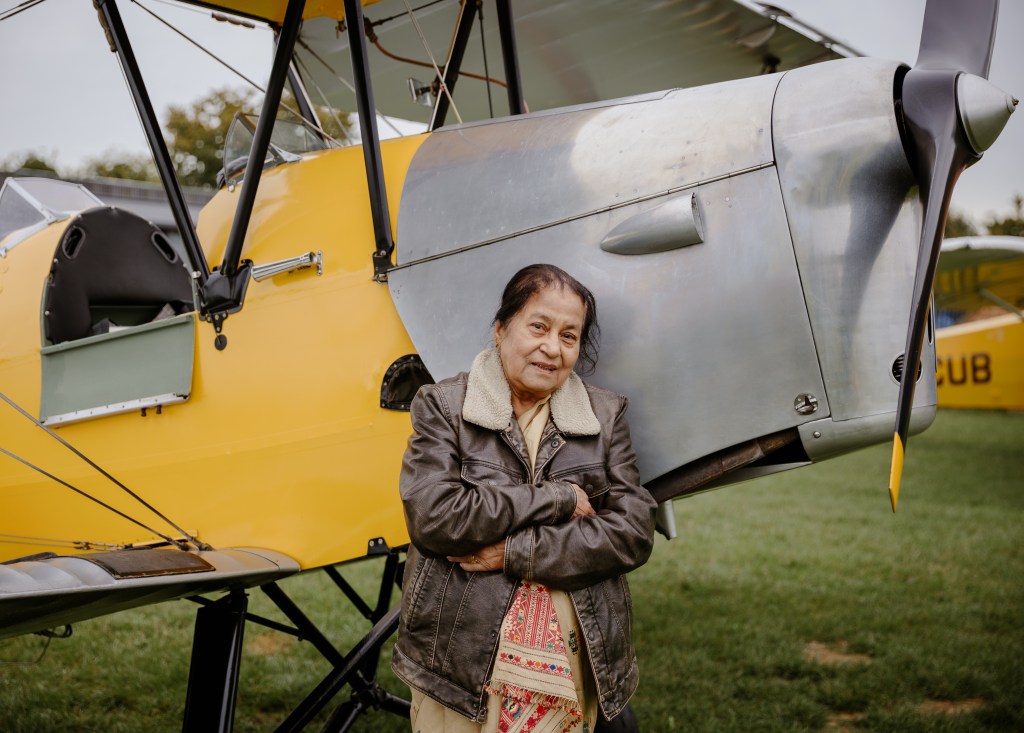
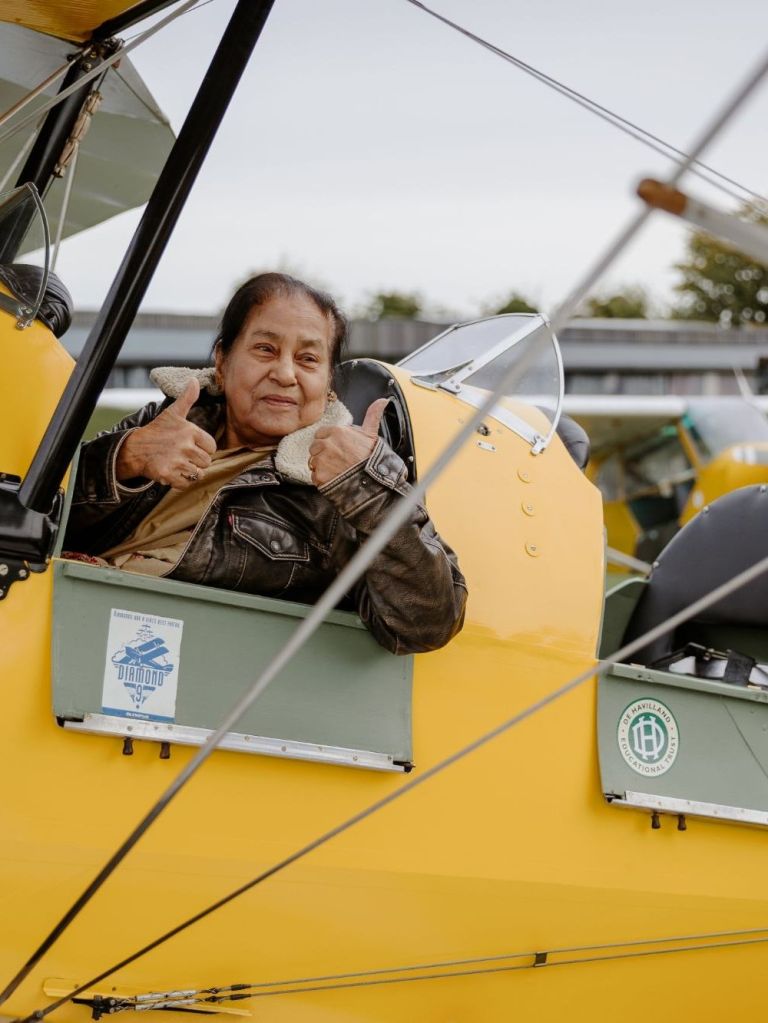
As we got closer, the unmistakable shape of single engined biplane with a silver nose and tail revealed itself – it was the de Havilland Tiger Moth, the same type of plane my mum had flown over 65 years ago, and by some wonderful coincidence built in 1940 the same year of her birth.
She broke out in to a large smile. I can only imagine what was going through her mind, excitement, jitters. That tingle in the spine of a child-like excitement. Those memories of adventures in the skies all those years ago must have came flooding back to her in an instant.
Mum then asked me if she could borrow my jacket as it would be cold up there and it was then that I realised that this wasn’t going to be just a photo-shoot. My mum would fly again in the beckoning skies above England.
To an observer unaware of my mum’s achievements, she may have looked out of place ascending the aircraft. An 85 year old Indian lady in a silk sari, diminitive at five foot three inches climbing in to the cockpit. To the unknowing observer, the sight would have appeared incongrous.
But then that’s exactly what people said to her in 1950s when she was a teenager. Women have no place in flying they said. And just like then, she just carried on regardless.
My mum may be diminutive in stature, but she is lion-hearted in spirit.
To ascend a Tiger Moth you have to climb on to its wing and step on specific marked-out spots, designed to support weight. She climbed with a certain sure-footed self-assuredness of somone who had done it numerous times before. And ofcourse, she really had.
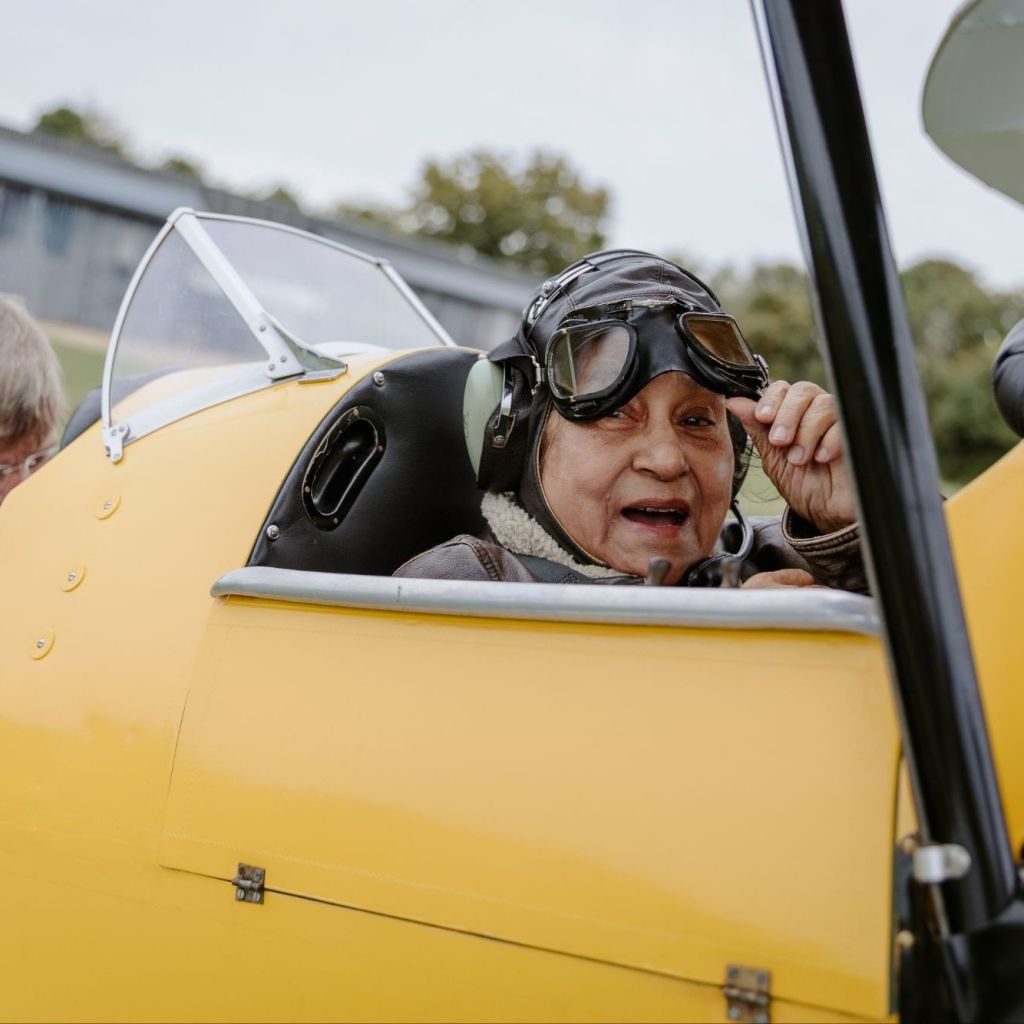
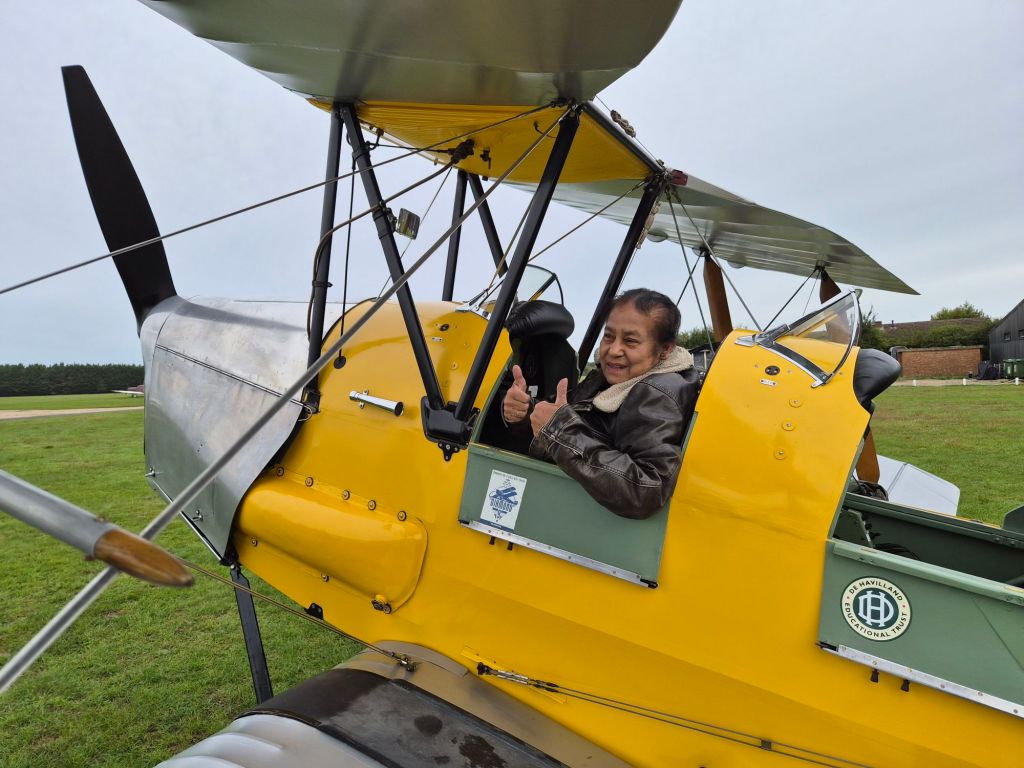
She climbed in to the seat of the plane with Linda’s help and John helped secure her with seatbelts and put on a leather helmet, goggles and an ear-piece and gave her a pre-flight briefing. Then John pushed hard down on the propellers, and a roar of the engine, hundreds of horsepower, sputtered to life.
Through the propellors I could see mum in her helmet and goggles, beaming the beamiest smile you ever saw, thumbs in the air, eager for takeoff.
The Tiger Moth taxied across the grass, bobbing across the undulating lay of the land and then a few minutes later, she taxied and the plane took off.
They flew for 30 minutes. John said mum was very pensive. She was lost in thoughts from 65 years ago.
I’m sure above the patchwork fields of wheat and barley in England’s rolling countryside, she saw the paddy fields, areca palm groves and banana trees of Assam.
For the Chiltern Hills she saw Nilachal and when they flew over the River Thames at Marlow, she imagined the magnificence of the Brahmaputra.
And in the cold air of the open cockpit, through the grey clouds over the clustered rooftops, she felt the Assamese sunshine in the blue skies of her younger years. And perhaps the stone towers of Marlow’s suspension bridge brought back the time she flew between the pillars of the Saraighat Bridge.
As mum descended the Tiger Moth, she was still smiling and posed for more photos.
We said our goodbyes to the lovely Towell family. Mum didn’t stop smiling. “Mission accomplished,” she said as she put away her flying badge and licence.
Back in India, as the news spread that Dhira Chaliha had flown again, she went viral on social media. The Chief Minister of Assam, Shri Hemanta Biswas Sarma lauded her and Harpreet Singh, the Chief Executive of Air India and the first woman to fly for Air India, received her at Delhi Airport. Shri Anand Mahindra tweeted:
She deserves a place in India’s Aviation Hall of Fame simply for being a trailblzaer. But for flying again at the age of 85, she belongs in a Global Hall of Fame, for her courage, her resilience and her life affirming spirit.
 Hey Loons
hello! I chanced upon your blog and reading about your amazing Mum had me hooked. As a daughter of an Indian mother who was also way ahead of her times and broke many many glass ceilings , your Mother’s story really resonated with me. What an incredible woman! And to do it all effortlessly and gracefully in an Indian sari, is symbolic in so many ways. Thank you for sharing
LikeLike
Hi Loona:
Reading about Dhiraj khuri is always exciting. She has the same verve, sprite that she brought with her in 1963 and, amazing as it is, l have hardly seen any change in her…. After all, she is my aunt!
LikeLike
Hi Loona
its me, Latimoni
LikeLike
I remember reading that story a few years back. The encore is just as inspiring – maybe more.
LikeLike
Thanks Dave!
LikeLiked by 1 person
Very inspiring and an amazing experience.
LikeLike